Do Certain Dog Breeds Have Higher Anesthetic Risk?
A multicenter study of over 55,000 canine anesthesia cases reveals which breeds face higher anesthetic mortality—and why health status matters more than breed alone for most patients.
View the original post on Instagram
Which dog breeds are predisposed to experiencing anesthetic mortality? Should anesthetic care be based primarily on breed, overall health status, or a combination of both?
Objective
Are there distinguished canine breeds with higher anesthetic risk—both before and after ASA Status assessment? Does ASA Status across these breeds correlate with their anesthetic mortality rates? Are these risks solely breed-specific or multifactorial?
Study Design
Multicenter analysis of over 55,000 canine anesthesia cases across North America, South America, and Europe. Analysis categorized whether dogs were alive or dead within 48 hours of anesthesia. Excluded cases where death was due to euthanasia or unrelated to anesthesia. Total cases analyzed: n = 54,542—a very large sample size for veterinary medicine, which adds validity to results.

Cases were primarily grouped by breed, followed with subsequent grouping by:
- FCI group & section — Fédération Cynologique Internationale (FCI) is the international equivalent to the American Kennel Club (AKC) that groups dogs based on shared morphological traits. Consider: is the FCI the most accurate standard in classifying dog breeds given the purpose of this study?
- Brachycephalic or Non-brachycephalic — based on BOAS literature determining what phenotype classifies a dog as brachycephalic
- MDR1-associated breeds or Non-MDR1 — based on MDR1/ABCB1 literature determining what genotype classifies a dog as a potential carrier for the mutation
Results
Overall mortality within 48 hours of anesthesia: alive n = 54,164 and dead n = 378. Overall anesthetic-related mortality rate = 0.7% (n = 378 / 55,542). Mixed-breed dogs were the largest population (n = 16,129 / 55,542) in the analysis with an overall anesthesia-related mortality rate of 0.68% (n = 109 / 16,129).
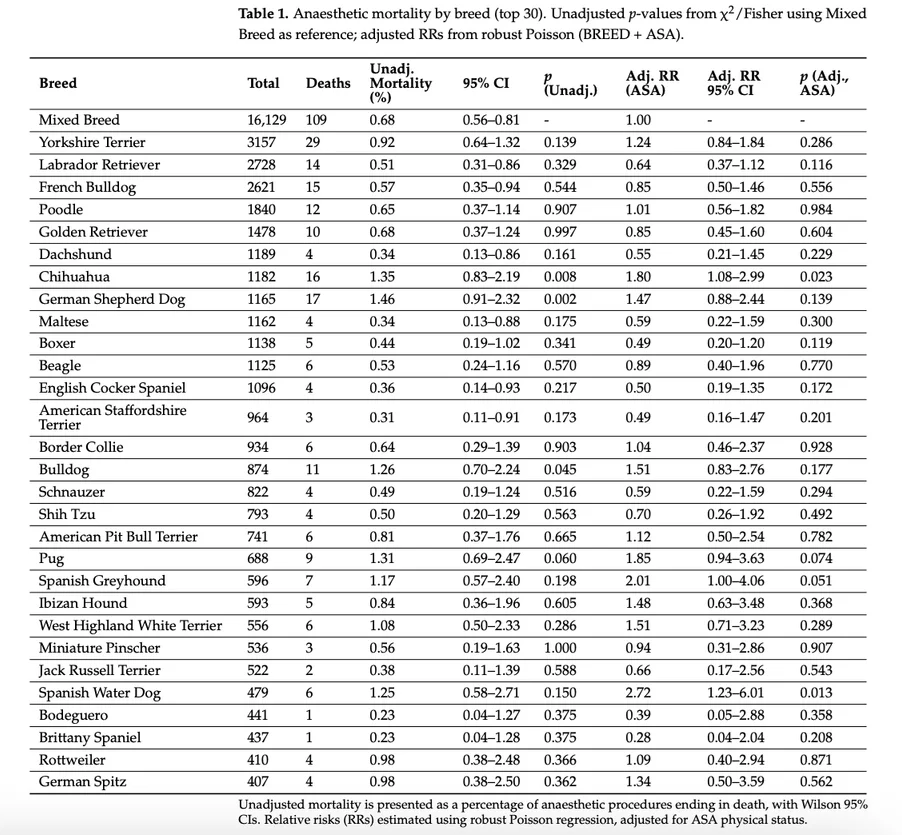
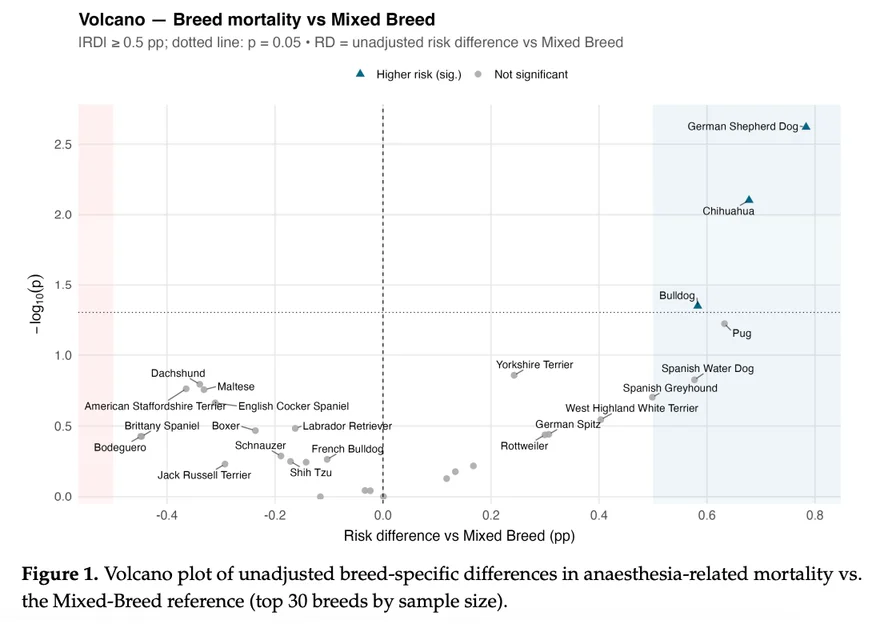
Breed-specific mortality rates: German Shepherds, Chihuahuas, and Bulldogs had the highest risk of anesthetic-related death. When adjusting for ASA Status (i.e. removing ASA Status as a factor):
- Only Chihuahuas remained with high risk of anesthetic-related death
- GSD & Bulldogs showed no significant higher risk after ASA adjustment
- Spanish Water Dogs entered as a breed with high risk of anesthetic-related death
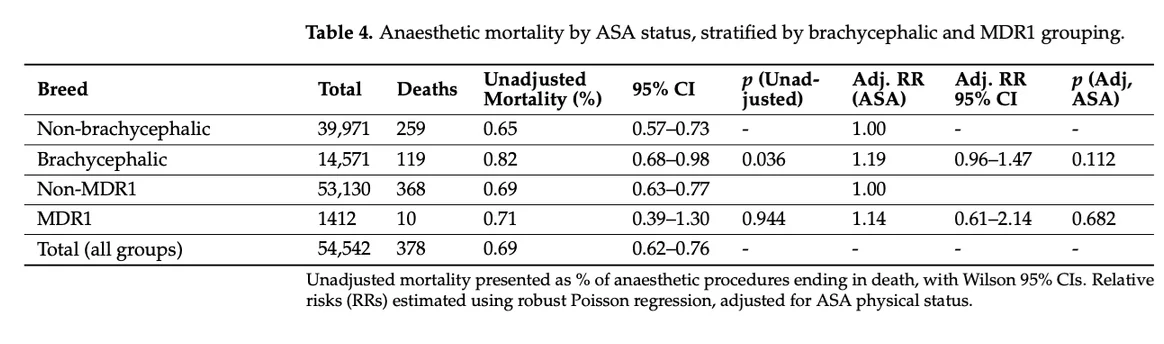
Brachycephalic-specific mortality rates: 0.2% higher anesthesia-related mortality rate (0.8%) compared to non-brachycephalics (0.6%). This difference was not maintained when adjusted for ASA Status.
MDR1-specific mortality rates: no significant difference in anesthesia-related mortality compared to other breeds (MDR1 rates = 0.71%). This result was maintained after adjustment for ASA Status.
Conclusions
- Overall canine anesthesia-related mortality rates are low at 0.7%
- Canine breeds that showed higher anesthesia-related mortality rates: German Shepherds, Chihuahuas, and Bulldogs
- Chihuahuas were the only breed to maintain a higher risk with or without considering ASA Status
- These findings validate the current literature that emphasizes the importance of health status (often indicated by ASA Status) & procedure type as the primary determinants of anesthetic mortality, whereas breed-specific considerations only play a significant role for a few select canine breeds
Suspicions as to why Chihuahuas maintained higher anesthetic risk even without ASA Status considered:
- Small size predisposes higher incidence of hypothermia (separate determinant of negative anesthetic results)
- Predisposed to airway collapse with excessive anesthetic depth
MDR1-associated breeds showed no higher risk for anesthesia-related death compared to other dog breeds. Possibility for lack of difference found: the mutation’s increased sensitivity to anesthetic agents may be properly mitigated in modern-day veterinary anesthesia care standards. MDR1 dogs in this study were classified based on breed-proxy rather than confirmed genetic mutation status (i.e. dogs truly carriers may be quite low).
Limitations
Various case factors that may have altered results were not analyzed:
- Anesthetic agents utilized (i.e. Chihuahuas received more of a specific drug which may have its own direct impact on anesthetic-related mortality)
- Pre-anesthetic labwork or physiologic variables (i.e. Bulldogs were more likely to have hypoxemia and respiratory compromise prior to anesthesia compared to other breeds)
- Urgency of anesthesia (i.e. GSDs were more likely to require emergent anesthesia for issues such as GDV or hemocavitation, which emergent cases have been shown to have higher anesthetic-mortality rates for a multitude of reasons)
- Anesthesia-related morbidity was not assessed across breeds — are certain breeds more likely to experience anesthetic-related morbidity events, but not necessarily mortality or death?
While overall anesthesia-related mortality rates are low in dogs, certain breeds (GSD, Chihuahua, Bulldog) are more at risk. “ASA Status-focused & breed-aware” methods should be considered when providing gold-standard anesthetic care.
Get In Touch
Want to learn more?
Whether you're looking for hands-on training or expert consultation, MACvet™ is here to support your team and your patients.